Vents
Tensentric instruments provide efficient and hands-off analysis of lab samples, replacing complex, time-consuming and potentially error-prone steps crucial for diagnosing diseases, monitoring health and guiding treatment decisions. Our systems incorporate the functionalities of a biochemical laboratory. Processes such as the mixing of liquids, DNA synthesis, bioseparation, aliquoting, amplification of biomolecules, or detection of specific substances by optical or electrochemical methods can be integrated in a cartridge. Our systems include components such as filters, pumps, valves, mixers, and sensors. Cartridges can isolate and manage internal substances for safe disposal after use, including sensitive lyophilized reagents, substances needing protection from environmental exposure, hazardous chemicals, or biological samples, while removing the possibility of cross-contamination. These systems can perform complex processes in point-of-care environments, saving time and cost by eliminating the need for specialized labs and highly trained technicians and by streamlining tedious multi-stepped processes that often require expensive dedicated lab equipment.
Tensentric has developed specialized vents engineered to utilize fluid dynamics to control airflow, and manage gases and fluids in microfluidic devices. These vents (often sterile filtration membranes) enable removal of gas bubbles, helping equalize pressure within the system and control flow within the channels.
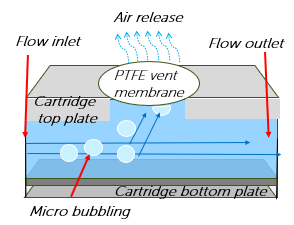
Hydrophobic Vents
Tensentric has developed specialized vents engineered to utilize fluid dynamics to control airflow, and manage gases and fluids in microfluidic devices. These vents (often sterile filtration membranes) enable removal of gas bubbles, helping equalize pressure within the system and control flow within the channels.
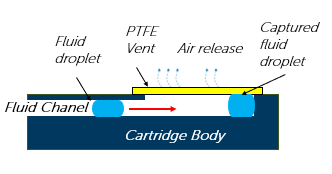
Pressure sensors are used to meter fluid and start or stop other operations during assay control. This is commonly done by pumping fluid through a channel to a hydrophobic vent. When the fluid reaches the vent, flow stops accompanied by a sudden rise in pressure. A pressure sensor detects this pressure spike and can turn off a pump or trigger other events of the assay. A prescribed volume can be captured within the channel that is repurposed by reversing flow from the channel, or by opening a valve and redirecting the fluid.
Hydrophobic vents can also be used to capture stray droplets of fluid by trapping them at the end of a vented channel. This method is used to clear any remnants of a reagent and purge a line for the next stage of an assay.
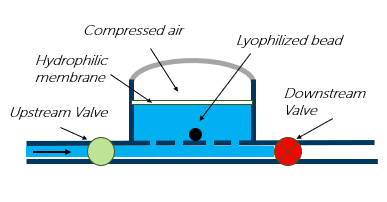 Pressure Reservoirs
Tensentric has engineered pressure reservoirs using membrane materials that act like passive pumps. A fluid is pumped into a chamber partitioned by a hydrophilic vent. As the chamber fills, the air above the vent is compressed. When the fluid rises to the level of the membrane, the pressure spikes, and the upstream valve closes. The reservoir remains sealed until a downstream valve is opened, whereupon the fluid is released downstream. This isolates a timed reaction within the reservoir, releasing the reagent using captured pressure.