Sensing Capabilities
Tensentric instruments provide efficient and hands-off analysis of lab samples, replacing complex, time-consuming and potentially error-prone steps crucial for diagnosing diseases, monitoring health and guiding treatment decisions. Our systems incorporate the functionalities of a biochemical laboratory. Processes such as the mixing of liquids, DNA synthesis, bioseparation, aliquoting, amplification of biomolecules, or detection of specific substances by optical or electrochemical methods can be integrated in a cartridge. Our systems include components such as filters, pumps, valves, mixers, and sensors. Cartridges can isolate and manage internal substances for safe disposal after use, including sensitive lyophilized reagents, substances needing protection from environmental exposure, hazardous chemicals, or biological samples, while removing the possibility of cross-contamination. These systems can perform complex processes in point-of-care environments, saving time and cost by eliminating the need for specialized labs and highly trained technicians and by streamlining tedious multi-stepped processes that often require expensive dedicated lab equipment.
Tensentric’s team of engineers are optics experts, we have developed fluid sensing technologies that perform an array of functions for processes including fluid presence detection, qPCR, fluid density measurement, pressure sensing, and antibody detection.
Fluid Presence Sensors
Clear fluids can be typically detected using an infrared emitter/detector pair, where the electrical signal changes in the presence/absence of fluid. They are used to determine when the leading or trailing edge of a fluid bolus has passed the sensor. This serves to meter fluid volume or trigger other events in the cartridge such as closing or opening valves to start, stop or redirect fluid flow. A pair of sensors can measure fluid velocity within a channel to provide feedback control for regulating velocity or time other events. Fluid sensors can also serve as a safety measure to ensure a process was completed, or to prevent overfill.
qPCR Sensing
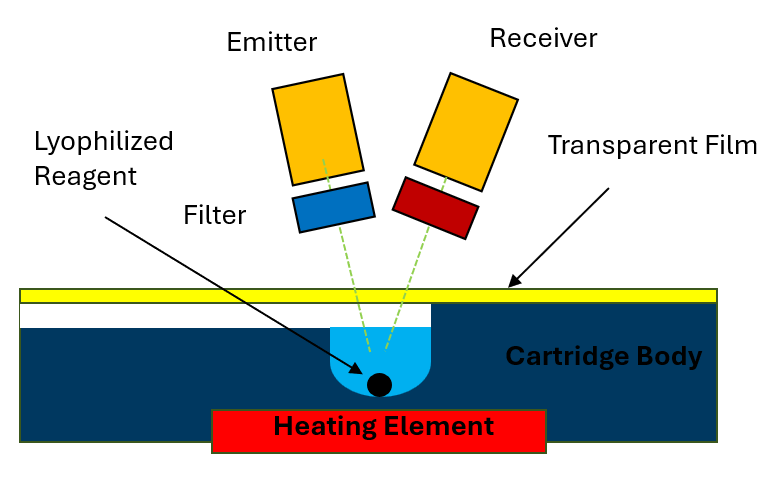
Tensentric has developed cartridge detection wells that are pre-filled with lyophilized oligos. The wells are in contact with a heating element. A DNA solution fills the wells and is heat-cycled to replicate DNA while an LED emitter excites a fluorophore bound to the DNA. The signal is detected by a photo-multiplier tube (PMT) or multipixel photo counter (MPPC) and monitored during the qPCR process. This technique enables the user to correlate a relative fluorescent output to the presence of a targeted pathogen.
Blood Droplet Sensor
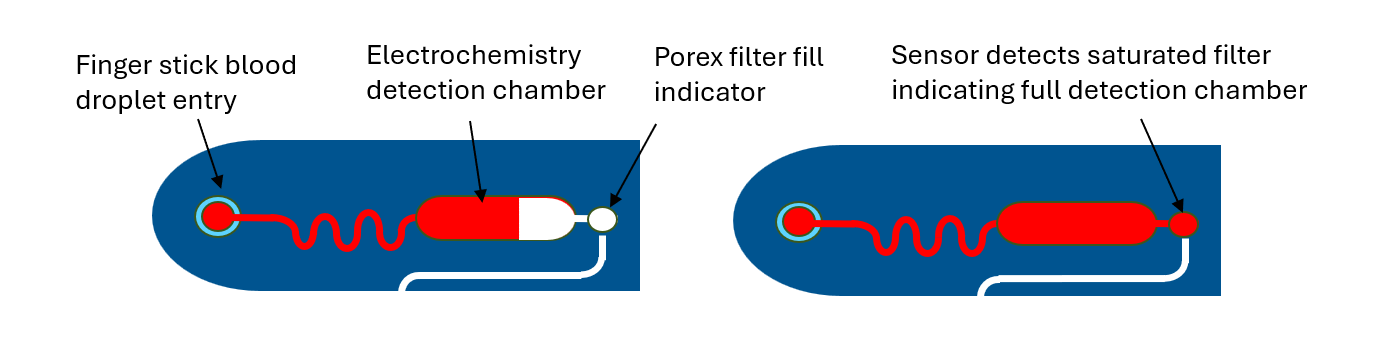
Tensentric developed a sensor to visually detect a droplet of blood drawn into a microfluidic chamber under capillary action. Detecting the droplet ensures that a sufficient volume of blood has been retrieved from a patient’s finger prick to complete an assay.
Optical Density Sensing
Tensentric has used emitter/detector sensor pairs to provide a measure of fluid cell density or fluid concentration. This is used to monitor processes and ensure a prescribed cell density or fluid concentration is achieved. Fluid concentration sensors typically operate in the visible light spectrum (400-700 nm) or infrared.
Sensors can provide system control feedback to continuously adjust process parameters to ensure prescribed concentrations.

Pressure Sensing
Additionally, we can use force gauges in the instrument to measure pressure in an adjacent fluid path within a cartridge. A flexible membrane covers a fluid chamber connected to a fluid path and a plunger under spring preload contacts the surface of the flexible layer. As pressure in the fluid path increases, the plunger force against the sensor increases proportionally. The sensor reading can be calibrated to measure the pressure of the fluid beneath the membrane.
Pressure sensors in the instrument can be used to monitor air pressure at a cartridge air inlet or outlet port. This is used to maintain a specified pump pressure through feedback control. Pressure sensors provide monitoring to detect an occlusion (blockage) or leak in a fluid channel.