Manufacturing
Tensentric instruments provide efficient and hands-off analysis of lab samples, replacing complex, time-consuming and potentially error-prone steps crucial for diagnosing diseases, monitoring health and guiding treatment decisions. Our systems incorporate the functionalities of a biochemical laboratory. Processes such as the mixing of liquids, DNA synthesis, bioseparation, aliquoting, amplification of biomolecules, or detection of specific substances by optical or electrochemical methods can be integrated in a cartridge. Our systems include components such as filters, pumps, valves, mixers, and sensors. Cartridges can isolate and manage internal substances for safe disposal after use, including sensitive lyophilized reagents, substances needing protection from environmental exposure, hazardous chemicals, or biological samples, while removing the possibility of cross-contamination. These systems can perform complex processes in point-of-care environments, saving time and cost by eliminating the need for specialized labs and highly trained technicians and by streamlining tedious multi-stepped processes that often require expensive dedicated lab equipment.
Tensentric has experience and manufacturing capabilities for low-to-high-volume cartridge assembly, including methods for joining cartridge materials such as laser welding, pressure sensitive adhesives (PSAs), ultrasonic and RF welding, press fits, bonding and heat sealing. Each can allow for a different element such as a valve or pump to be integrated.
Building- Thermoforming vs Injection Molding
Thermoforming: heating plastic sheets up to a malleable point so that it can be stretched over a mold, it includes limited materials and the designs could have weakened points in the structures due to uneven thicknesses. However, they can be easily reshaped, making them versatile and the manufacturing tooling is much easier to change.
Injection molding: Heating plastic pellets until it’s in a molten state and injecting it into a mold. The pressure forces the plastic to form into specific shapes, which allows the products to form small, detailed parts.
Laser Welding Capabilities
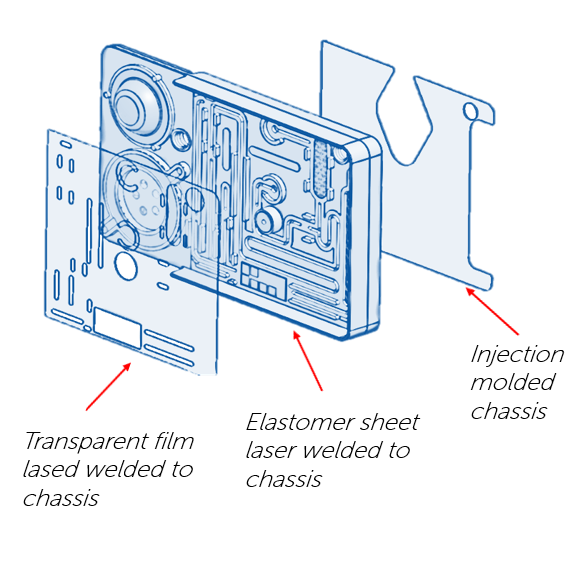
Laser welding joins dissimilar materials to create a sealed fluid channel. The cartridge below has a rigid injection molded chassis with a transparent film laser welded to one side and an elastomeric sheet laser welded to the opposite side. The transparent layer provides containment of the fluid paths while allowing sensors to detect fluid travel. The elastomeric sheet provides an interface for pinch valves that control the direction of flow.

Ultrasonic Welding Capabilities
Ultrasonic welding uses vibration and pressure to join similar plastics. The cartridge is joined by ultrasonically welding top and bottom polycarbonate layers together, sandwiching the middle silicone layer in compression. Raised regions in the top layer compress the silicone adjacent to the fluid channel to create a seal. The silicone layer also provides piston pumps, pinch valves and pressure sensors within a single component, producing a low-cost and easy to assemble design solution.
Pressure Sensitive Adhesives
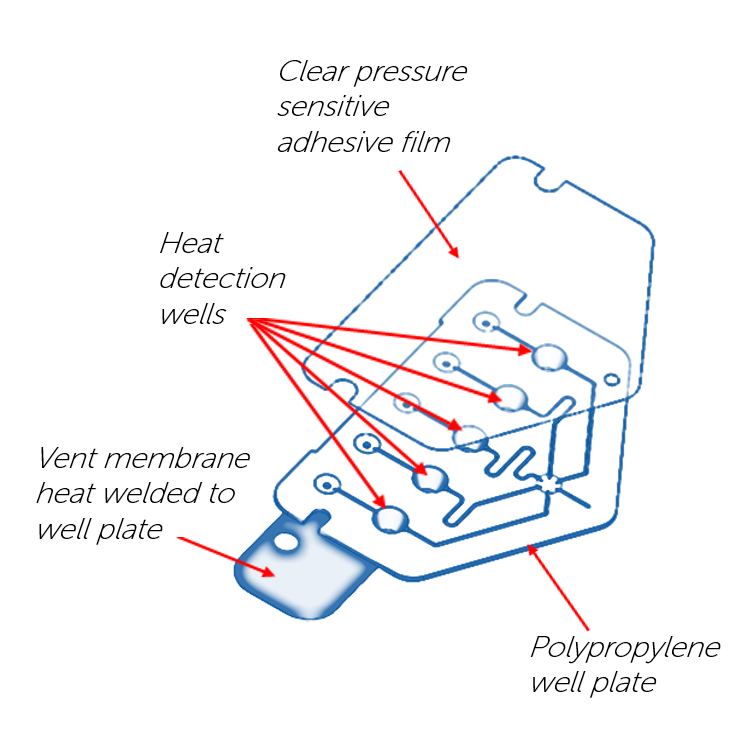
Pressure sensitive adhesives have been used to bond transparent films that seal fluidic channels. This cartridge element uses a clear pressure sensitive adhesive film bonded to a polypropylene well plate. The clear film allows scanning by a photo-multiplier detector, that converts low-light levels into a massive signal amplification. The wells are heat cycled for DNA replication throughout the scanning process, and a vent membrane is heat welded at the fluid channel exit.
Large Scale Manufacturing
Tensentric has designed cartridges compatible with large scale manufacturing. Features included during early development stages to accommodate conveyor systems with pick and place assembly capabilities and automation including cartridge sealing, reagent filling, blister sealing, and assembly. Statistical process control is used to maintain consistency and quality, and test points or ports are created to facilitate process monitoring and allow in-process inspection to eliminate defects.
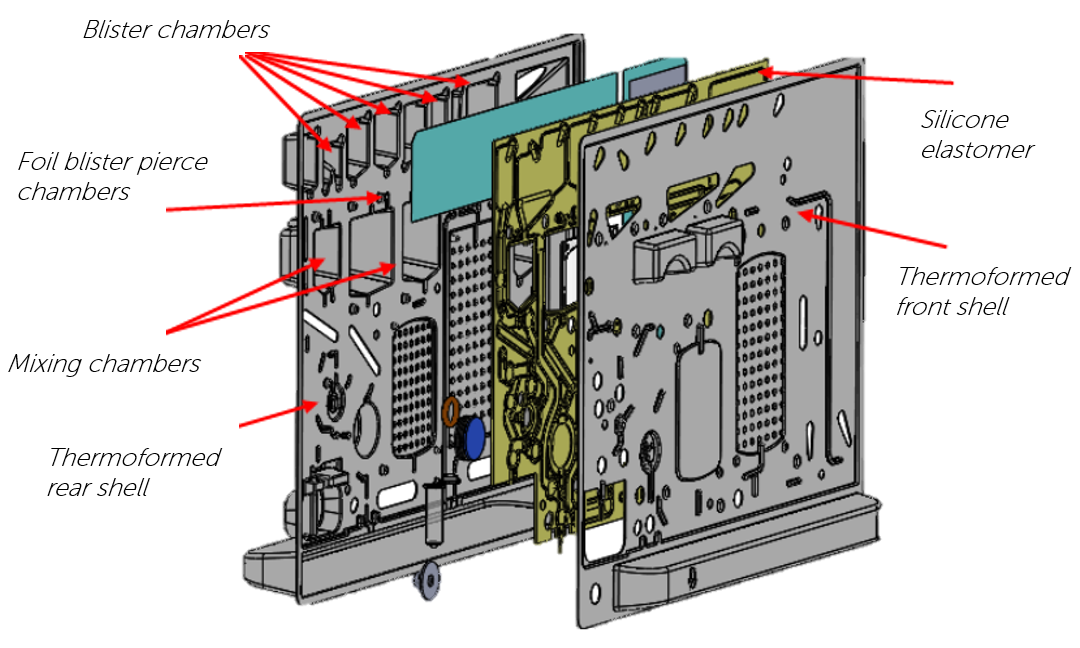
The cartridge shown uses unique materials and construction to produce a novel, low-cost solution, lending itself to high-volume manufacturing. For this larger sized cartridge, thermoforming was selected over injection molding. The multi-layer architecture has top and bottom thermoformed “shells” that are thermally welded (via RF) together around a middle elastomeric layer. The cartridge is clamped inside the instrument to hold the 3 layers in compression and seal all fluid channels.
- Foil is heat-sealed to the thermoformed sheet (after automated fluid dispense) to produce shelf-stable reagent cavities for processing stages of the assay.
- Stir bars are placed inside common chambers to mix reagents using a rotating magnet on the instrument.
- The elastomer layer provides a contamination-free interface for external linear peristaltic pumps, foil pierce actuators, and pinch valves.
- Filters are placed over alignment and retention posts, becoming captive between layers in the welded clamshell and integral with fluid paths.