
Materials
Tensentric instruments provide efficient and hands-off analysis of lab samples, replacing complex, time-consuming and potentially error-prone steps crucial for diagnosing diseases, monitoring health and guiding treatment decisions. Our systems incorporate the functionalities of a biochemical laboratory. Processes such as the mixing of liquids, DNA synthesis, bioseparation, aliquoting, amplification of biomolecules, or detection of specific substances by optical or electrochemical methods can be integrated in a cartridge. Our systems include components such as filters, pumps, valves, mixers, and sensors. Cartridges can isolate and manage internal substances for safe disposal after use, including sensitive lyophilized reagents, substances needing protection from environmental exposure, hazardous chemicals, or biological samples, while removing the possibility of cross-contamination. These systems can perform complex processes in point-of-care environments, saving time and cost by eliminating the need for specialized labs and highly trained technicians and by streamlining tedious multi-stepped processes that often require expensive dedicated lab equipment.
Material selection can be critical for engineering properties such as manufacturability, material strength, surface energy, optical clarity and shelf-life stability. Most importantly, materials must be selected that consider chemical or patient interactions, such as chemical inertness, biochemical process efficacy and patient safety (biocompatibility). Other variables that drive material selection include water absorption, permeability to water vapor, surface tension (hydrophobic or hydrophilic) as well as high temperature applications such as PCR.
Commonly used rigid materials include PMMA (Acrylic), PC (Polycarbonate), PS (Polystyrene), and ABS (Acrylonitrile Butadiene Styrene). Elastomeric materials include LSR (Liquid Silicone Rubber) for clarity and high temperature applications, TPE (Thermoplastic Rubber) for flexibility and purity, and Butyl Rubber for syringes and vials due to low permeability. Applications requiring optical characteristics may require COP (Cyclo-olefin-polymers), COC (Cyclo-olefin-copolymers) or highly polished polycarbonates.
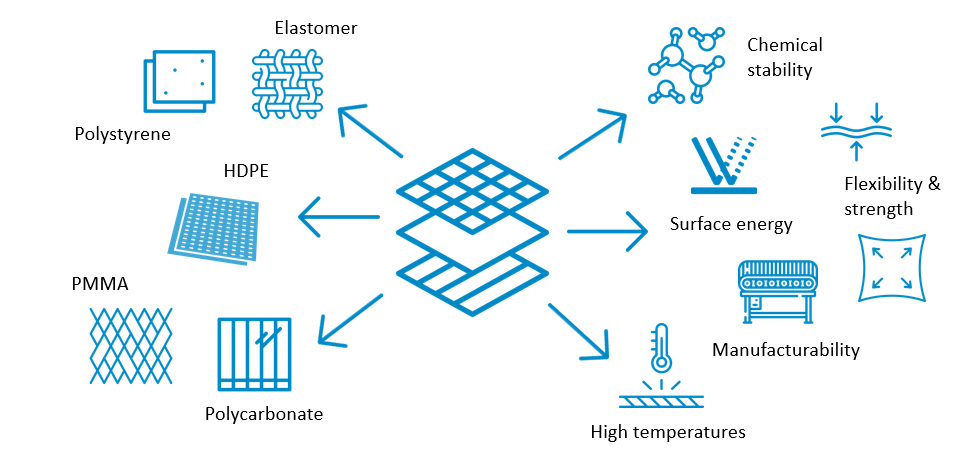
Cartridges typically combine rigid plastic housings with film covers or flexible elastomeric elements which are used to create sealing gaskets, pumps, and valves to drive fluidics through controlled paths. Methods to treat elastomeric materials, eliminating harmful outgassing byproducts that could compromise a biological assay, can be applied where needed.
Polymers are typically hydrophobic but can be modified through a hydrophilization process like plasma or corona discharge treatment to increase their surface energy, making them hydrophilic and increasing adhesion. Some polymers can be produced as thin films that are adhered or laser welded to a substrate to form fluidic channels and reservoirs. Other materials like HDPE are easily thermoformed to create fluid channels and reservoirs.
Tensentric has applied coatings and special processes (radiation) to fluidic surfaces to make them hydrophilic, hydrophobic, chemically inert, or sterile. We have developed materials and surface treatments that are compatible with or induce chemical reactions or facilitate biological processes (biochemical functionalization). This includes surfaces that promote cell specific or molecular attachments designed to initiate signaling cascades, support immobilization of biomolecules or are compatible with fluids that transport highly reactive or “sticky” molecules.