Pumps
Tensentric instruments provide efficient and hands-off analysis of lab samples, replacing complex, time-consuming and potentially error-prone steps crucial for diagnosing diseases, monitoring health and guiding treatment decisions. Our systems incorporate the functionalities of a biochemical laboratory. Processes such as the mixing of liquids, DNA synthesis, bioseparation, aliquoting, amplification of biomolecules, or detection of specific substances by optical or electrochemical methods can be integrated in a cartridge. Our systems include components such as filters, pumps, valves, mixers, and sensors. Cartridges can isolate and manage internal substances for safe disposal after use, including sensitive lyophilized reagents, substances needing protection from environmental exposure, hazardous chemicals, or biological samples, while removing the possibility of cross-contamination. These systems can perform complex processes in point-of-care environments, saving time and cost by eliminating the need for specialized labs and highly trained technicians and by streamlining tedious multi-stepped processes that often require expensive dedicated lab equipment.
Our cartridges incorporate sealed pump elements that interface with instrument–driven electromechanical actuators to induce fluid movement. Tensentric has developed unique interfaces to isolate internal cartridge fluids from the reusable components. We have developed pumps that dry out fluid suspended in an absorbent membrane, eliminating reagents that are undesirable for the final product. Pumps can operate with one or more pressure sensors using proportional integrated loop (PID) control to maintain a specified pressure. Below are examples of several custom pump designs.
Diaphragm Pump
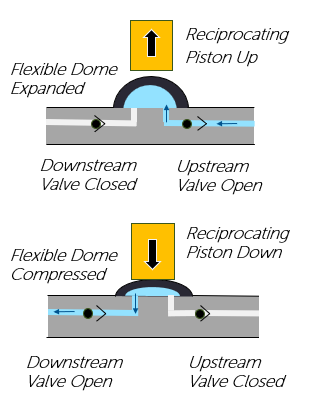
A diaphragm pump uses a flexible dome with one-way check valves (upstream and downstream) inside the cartridge that is cyclically compressed and released by an instrument-driven reciprocating piston. As the piston extends and the dome compresses, the upstream valve closes and the downstream valve opens, flushing fluid from the dome cavity downstream. As the piston retracts, the dome expands causing the upstream valve to open and the downstream valve to close, drawing fluid into the dome cavity. The reciprocating action of the piston drives fluid downstream. Design of the dome and check valves requires careful consideration of the durometer and geometry to ensure sufficient restoring force and intended flow rate while minimizing system fluid loss to offer efficient control of microfluidics.
Syringe Pump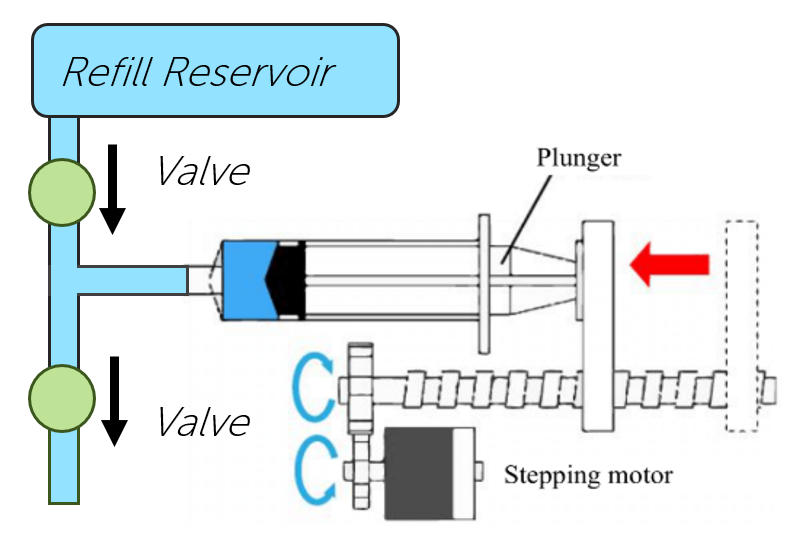
A syringe pump is an external pump that drives a controlled volume of air or fluid in or out of a cartridge. Air or fluid enters the cartridge through a sealed port to drive downstream fluidics. Tensentric has developed custom syringe pumps for special applications and lower-cost solutions which can be beneficial as it can accurately dispense a controlled volume, typically using a stepper motor.
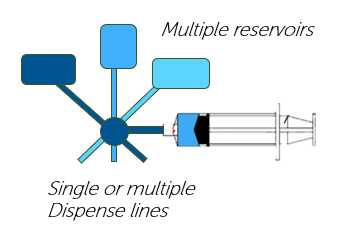
Syringe pumps can be configured with turret valving to dispense from multiple reservoirs and/or to multiple lines.
Piston Pumps
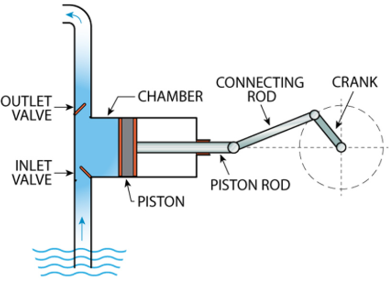
Piston pumps use a reciprocating piston and a pair of valves to draw fluid from a reservoir as the piston retracts and pushes the fluid downstream as the piston extends. The piston is typically driven by a rotating crank or eccentric cam, and is designed for continuous pumping, where less accurate metering of volume is required. Tensentric has developed both piston pumps incorporated into cartridges and pumps driven by an actuator within the instrument.
Peristaltic Pump
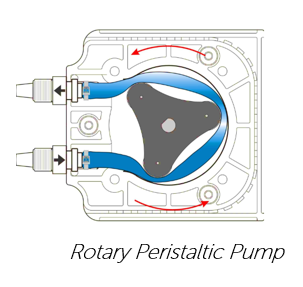
A peristaltic pump is a displacement pump that moves fluids in either direction by squeezing a flexible tube. Rotary peristaltic pumps use rollers on a rotating shaft, which compresses the tubing, drawing fluid in from upstream and pushing it downstream. The design ensures that only tubing contacts the fluid, preventing contamination.
Linear Peristaltic Pump
Rotary peristaltic pumps are not ideal for cartridges because they require a tube set to be manually loaded into the pump body (or risk permanent deformation if pre-loaded and stored for long periods). To eliminate this problem, Tensentric has designed linear peristaltic pumps that use a series of finger-like pistons to compress a flexible fluid channel. The pistons move in a wave form pattern to drive fluid downstream or upstream. A single rotary cam interacts with the pistons to produce the wave-like motion, and the pump interfaces with a cartridge by simply clamping against the fluid channel on-plane.

Piezoelectric Disc Pump
A disc pump is a miniature external pump that drives air in or out of a cartridge through a sealed port. They operate by rapidly moving a flexible disc-shaped membrane in a wave form that creates a pressure gradient between the outer periphery and the center of the disk. They can only drive air and must drive internal fluidics with external air pressure. But they are lower cost compared to syringe pumps and can provide highly accurate and smooth flow control –ideal for cartridges requiring precise fluid delivery.